September 21, 2026 · TrueVortex
You May Not Have a Customer Problem. You May Have a Customer Intelligence Problem.
You have customers, transactions and data. The harder question is who you should be talking to today — and what that information actually means.
- growth
- customer intelligence
- retail marketing
- growth intelligence
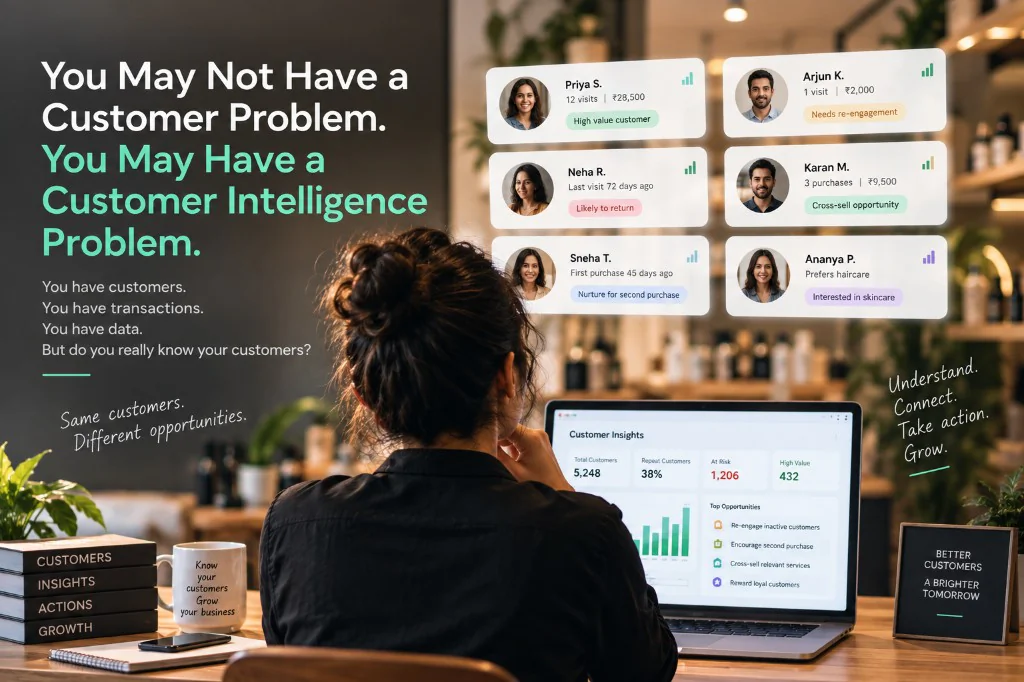
You have 5,000 customers.
Maybe 10,000.
Maybe 50,000.
You know how many customers you have.
You probably know how much revenue they generated.
You may even know what they purchased.
But how well do you actually know them?
Who are your most valuable customers?
Who hasn't purchased from you recently?
Who usually comes back every month but hasn't returned this time?
Who purchased once and never came back?
Who buys one category but has never tried another?
Who is likely to respond to a particular offer?
And perhaps the most important question:
Who should you be talking to today?
For many businesses, answering these questions still requires pulling data from different systems, creating spreadsheets, applying filters and relying on someone's experience to figure out what to do next.
The data exists.
But the intelligence isn't always easily accessible.
A customer database isn't customer intelligence
Having customer data is not the same as understanding your customers.
A database might tell you:
- Customer A purchased ₹8,500 worth of products.
- Customer B visited three times this year.
- Customer C purchased a particular service.
- Customer D hasn't purchased in six months.
Useful information.
But information becomes much more valuable when it starts answering questions.
Why is Customer A valuable?
Is Customer B's purchase frequency increasing or decreasing?
Is Customer C likely to be interested in another service?
Why hasn't Customer D returned?
What do these customers have in common?
And what should the business do about it?
That's the difference between customer data and customer intelligence.
Customer data tells you what happened.
Customer intelligence helps you understand what it means and what you might do next.
The problem with treating every customer the same
Imagine a business with 10,000 customers.
It launches a campaign and sends the same message to all 10,000.
It might generate some responses.
But consider what happens when the business starts looking at those customers differently.
Perhaps 1,500 are recent customers.
2,000 haven't purchased in more than 90 days.
500 are high-value customers.
1,200 have purchased only once.
800 regularly purchase a particular category.
Some belong to multiple groups.
Suddenly, 10,000 customers isn't one audience anymore.
It's a collection of very different customer situations.
And those situations should lead to different actions.
A customer who purchased yesterday probably doesn't need the same message as someone who hasn't purchased in six months.
A high-value loyal customer probably shouldn't receive the same communication as someone who has made a single purchase.
A customer who regularly purchases a particular category may respond differently to a complementary product than someone who has never purchased it.
The more we understand these differences, the more relevant marketing can become.
Segmentation is only the beginning
Businesses have been segmenting customers for years.
Age.
Gender.
Location.
Purchase history.
Customer type.
Revenue.
These are useful dimensions.
But modern customer intelligence can go much further.
Consider behaviour.
A customer might:
- Purchase every 30–45 days.
- Usually spend around ₹3,000.
- Prefer a particular category.
- Respond to WhatsApp but not email.
- Purchase more during certain periods.
- Have recently reduced their purchase frequency.
Each individual signal may not mean much.
Together, they can tell a much more useful story.
The opportunity is not simply to create more segments.
It is to identify meaningful signals and connect them to actions.
From segments to signals
This distinction matters.
A segment might say:
Customers who haven't purchased in 90 days.
A signal might say:
This customer normally purchases every 45 days and is now 40 days overdue.
The second tells us much more.
It introduces context.
That context can change what the business does.
Instead of waiting until a customer is completely inactive, the business can potentially act when behaviour starts to change.
This can apply to almost any customer-facing business.
A salon might notice that a regular customer has passed their usual appointment cycle.
A fashion brand might notice that a customer who frequently purchased one category has stopped engaging.
A gym might notice a significant drop in attendance.
A restaurant might notice that a previously frequent customer hasn't visited for several weeks.
A D2C brand might identify customers whose first purchase hasn't yet turned into a second purchase.
These aren't just customer lists.
They are growth signals.
The real question is what happens next
Customer intelligence becomes valuable only when it leads to action.
Knowing that 2,000 customers haven't purchased recently is interesting.
Knowing which 200 are most likely to return, why they might return, and what action could encourage them to do so is much more useful.
That creates a chain:
Customer data → Intelligence → Audience → Action → Outcome
For example:
A customer has purchased three times in the past year.
Their normal purchase interval is approximately 60 days.
It has now been 85 days.
The system identifies the change.
The customer becomes part of a re-engagement audience.
The business sends a relevant message.
The customer returns.
That interaction creates another data point.
The system now knows a little more about the customer.
The next decision can potentially be better.
This is how customer intelligence starts becoming a growth system rather than simply another dashboard.
The infrastructure challenge
For e-commerce businesses, much of the underlying data may already exist.
Shopify or another commerce platform may contain orders and customer information.
Analytics platforms capture website behaviour.
Advertising platforms capture campaign interactions.
Email and messaging platforms capture engagement.
CRMs contain customer records.
For physical businesses, the picture can be more fragmented.
Customer information may sit in POS systems, spreadsheets, WhatsApp conversations, loyalty programs and other tools.
The level of infrastructure is different.
But the fundamental challenge is similar:
How do you bring these signals together and turn them into useful decisions?
More data alone doesn't solve the problem.
In fact, more disconnected data can sometimes make the problem harder.
The goal isn't to collect everything.
The goal is to make the information that matters understandable and actionable.
What good customer intelligence should feel like
Ideally, a business owner shouldn't have to spend hours asking:
"Which customers should I target?"
"Can someone export this data?"
"Can we put this into a spreadsheet?"
"Can someone check what they purchased?"
"Who responded to the last campaign?"
The system should increasingly surface useful opportunities on its own.
Something like:
42 customers are approaching their usual repurchase window.
Or:
18 high-value customers haven't returned within their normal purchase cycle.
Or:
126 customers made their first purchase more than 45 days ago but haven't purchased again.
Now the business has something to work with.
The question changes from:
"What marketing should we do?"
to:
"Which customer opportunity should we act on next?"
That is a much more useful question.
Where AI can change the equation
This is one of the areas where AI becomes particularly interesting.
Traditional software is very good at storing data, applying filters and executing predefined rules.
AI can potentially help with something different:
understanding context.
Instead of requiring a business owner to define every possible rule, an AI system could look across customer behaviour and identify patterns worth investigating.
It could help explain:
- Why a particular customer group matters.
- What has changed in their behaviour.
- Which customers appear to be becoming inactive.
- Which customers have similar purchase patterns.
- Which opportunity might deserve attention.
- What action could be appropriate.
The important part isn't simply generating an answer.
It is connecting the answer back to the actual business context.
Customer intelligence shouldn't become another report that someone reads once a month.
It should become part of how the business operates every day.
Building a customer intelligence layer
The long-term opportunity is to move beyond disconnected customer databases and campaign tools.
Imagine a layer that continuously brings together what the business knows about its customers, understands the patterns within that data, identifies meaningful opportunities and helps the business act on them.
Not another dashboard.
Not another spreadsheet.
Not simply another campaign tool.
A layer that helps answer:
Who matters right now?
What has changed?
Why does it matter?
What should we do?
What happened afterwards?
What did we learn?
That is what we mean when we talk about building customer intelligence.
The objective isn't to know everything about every customer.
It is to know enough about the right customers, at the right moment, to make better decisions.
Because ultimately, better marketing doesn't start with another campaign.
It starts with understanding the customer.
This is the second essay in a series on the growth system behind retail marketing. The first looked at too many activities, not enough system.
We're exploring what this kind of customer intelligence layer could look like for modern businesses.
Follow TrueVortex as we share what we're learning while building it.