September 20, 2026 · TrueVortex
The Retail Marketing Problem: Too Many Activities, Not Enough System
Retail businesses are doing more marketing than ever. But more channels, tools and campaigns don't necessarily create a better growth system. Here's where the gap lies.
- growth
- retail marketing
- customer intelligence
- growth intelligence
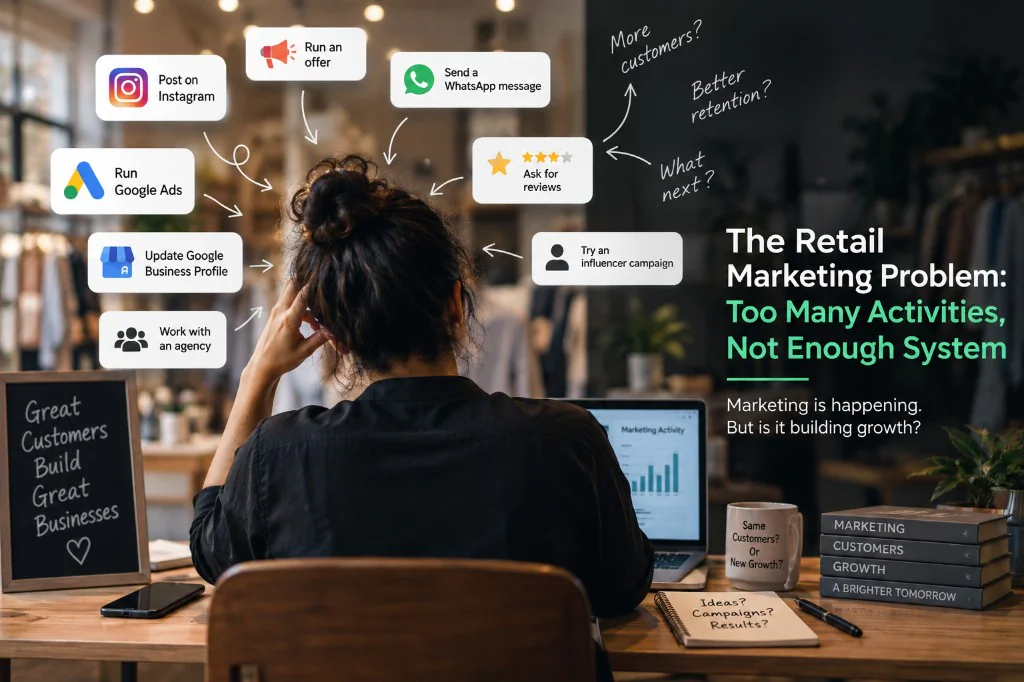
Marketing a retail business can feel deceptively simple.
Post something on Instagram.
Run an offer.
Send a WhatsApp message.
Run some Google Ads.
Ask customers for reviews.
Update the Google Business Profile.
Maybe work with an agency.
Maybe try an influencer campaign.
There is always something to do.
And yet, after all that activity, a business owner can still struggle to answer some very basic questions:
- Which customers are we actually trying to reach?
- Which campaigns are bringing customers back?
- Who hasn't visited us recently?
- Which customers are most valuable to the business?
- What should we communicate to them next?
This is where retail marketing gets interesting.
The problem isn't necessarily a lack of marketing activity.
It is often the lack of a system connecting all those activities together.
Marketing becomes a collection of tasks
For many storefront businesses, marketing grows organically.
Someone starts an Instagram page.
Someone else starts running ads.
A team member manages the Google Business Profile.
WhatsApp becomes the place for customer communication.
The POS holds transaction history.
Customer information might exist in spreadsheets, phones, loyalty programs or different software.
Each piece can work reasonably well on its own.
But they rarely work together as one system.
The result is a business that is doing marketing without necessarily having a clear marketing engine.
And this isn't limited to physical stores.
A growing D2C or e-commerce business can have a much more sophisticated stack — Shopify, CRM, email, Meta Ads, Google Ads, analytics and automation tools.
The problem simply moves to a different place.
There may be more data.
There may be more tools.
There may be more automation.
But the business can still struggle to turn all of that information into a clear answer to one simple question:
What should we do next?
Consider a simple example
Imagine a salon with 3,000 customers.
The business knows that these customers have visited before.
It may even know what they purchased.
But can it easily answer:
- Which customers haven't visited in 90 days?
- Which customers usually return every 30–45 days?
- Which customers have spent more than ₹20,000 over the past year?
- Which customers only purchase a particular service?
- Which customers visited once but never returned?
- Which customers might be interested in a new service?
- Which customers should receive an offer this week?
- Which customers shouldn't receive that offer because they just visited?
These aren't really advertising questions.
They're customer intelligence questions.
And once you can answer them, marketing becomes much more deliberate.
The same thing happens in e-commerce.
Imagine a D2C brand with 50,000 customers.
It may know what each customer bought, when they bought it, what they browsed, which emails they opened and which campaigns they interacted with.
But knowing all of that doesn't automatically tell the marketing team:
Who should we talk to today?
The infrastructure may be sophisticated.
The decision-making layer can still be surprisingly manual.
From broadcasting to relevance
There is a big difference between saying:
"We have a special offer this weekend. Visit us!"
and saying:
"You usually visit us every 5–6 weeks. It's been seven weeks since your last visit. Would you like us to help you book your next appointment?"
The second message isn't necessarily more creative.
It is simply more relevant.
That relevance comes from understanding the customer and the context around them.
The same principle applies across businesses.
A fashion store may want to reach customers who purchased a particular category but haven't returned recently.
A D2C brand may want to reconnect with customers who purchased once but haven't made a second purchase.
A gym may want to identify members whose attendance has dropped.
A jewellery store may want to reconnect with customers who purchased during a particular season.
A restaurant may want to engage customers who used to visit frequently but haven't returned recently.
The marketing action changes.
The underlying system is remarkably similar.
The missing layer
Most businesses already have pieces of the puzzle.
They have:
- Customers
- Transactions
- Conversations
- Products and services
- Social channels
- Marketing channels
- Campaigns
- Customer data
What is often missing is the layer that connects these pieces.
A simple way to think about that layer is:
Data → Understanding → Audience → Action → Measurement → Learning
That loop is what turns individual marketing activities into a growth system.
Without it, every campaign can feel like starting from scratch.
With it, every customer interaction can make the next decision a little smarter.
What does a growth system actually do?
A useful growth system should continuously help answer a set of questions.
Who should we focus on?
Not every customer needs the same message.
A new customer, a loyal customer, a high-value customer and a customer who hasn't returned in six months are at very different points in their relationship with the business.
Why them?
A good audience shouldn't just be a list of names.
There should be a reason behind the selection.
Maybe they are showing a particular behaviour.
Maybe they are approaching their usual repurchase cycle.
Maybe they have stopped engaging.
Maybe they have a high lifetime value.
Maybe they have purchased something that makes another product or service relevant.
What should we do?
Once an audience is identified, the next step should be clear.
A message.
An offer.
A recommendation.
A reminder.
A review request.
A product suggestion.
Or sometimes, no action at all.
What happened?
Did customers respond?
Did they purchase?
Did they return?
Did the campaign generate incremental business?
Did the audience behave differently from customers who weren't contacted?
What did we learn?
This is the part that often gets lost.
A campaign shouldn't simply end when the message is sent.
The result should improve our understanding of the customer and influence the next action.
That creates a continuous loop.
This is where AI becomes interesting
AI in marketing is often presented as a way to generate content faster.
Write an Instagram caption.
Create an advertisement.
Generate an image.
Write a WhatsApp message.
Draft an email.
Those are useful applications.
But they are only the visible part of the opportunity.
The more interesting question is:
What happens when AI can understand the business itself?
When it can understand customers, products, transactions, campaigns and interactions — and use that context to help decide what should happen next?
Instead of asking:
"Write me a marketing message."
we should eventually be able to ask:
"Which customers should I focus on this week, why, and what should I do with them?"
And the system should be able to reason from the context of the business, recommend an action, help execute it and measure what happened.
That changes the role of AI.
It moves from being a content-generation tool to becoming part of the growth infrastructure of the business.
Building the marketing muscle
A business shouldn't have to rely on a collection of disconnected activities to understand its customers and grow.
The goal should be to gradually build a marketing muscle inside the business.
A system that continuously answers:
Who should we focus on?
Why them?
What should we do?
When should we do it?
What happened?
What did we learn?
And then uses those learnings to make the next decision better.
That is a very different way of thinking about marketing.
It isn't about doing more marketing.
It is about making the marketing you already do more connected, more relevant and more measurable.
For some businesses, that journey starts with better infrastructure.
For others, the infrastructure already exists and the next challenge is connecting it intelligently.
Either way, the opportunity is the same:
Move from marketing activity to a system that continuously learns, acts and improves.
That is the marketing muscle businesses need to build.
We're exploring what this kind of growth system could look like for modern businesses.
Follow TrueVortex as we share what we're learning while building it.